

Commitment Devices: Psychological Follow-Through Systems
A commitment device is a structured arrangement that locks you into a future course of action by imposing real penalties for failure or removing alternative choices entirely. By altering future incentive structures while in a rational state, operators defeat present bias, overcome willpower limits, and force consistent follow-through on high-resistance goals.
The central dilemma of human productivity is temporal conflict: your rational present self makes ambitious commitments to ship products, write code, or build a company, but your future emotional self faces acute friction when execution time arrives. Under cognitive strain, the future self readily negotiates, makes excuses, and abandons the plan.
Relying on raw willpower to win this negotiation is an unreliable strategy. The prefrontal cortex tires quickly, while evolutionary dopamine pathways prioritize immediate relief over distant gains. To guarantee follow-through, high-output operators do not plead with their future selves; they bind them.
Originating in behavioral economics and game theory, commitment devices (frequently termed Ulysses contracts) introduce structural consequences that make inaction more painful than execution. By linking today’s execution to tomorrow’s financial, social, or environmental stakes, you eliminate overplanning vs execution paralysis and transform fragile ambition into reliable output.
Behavioral Mechanism and Core Framework
Human decision-making suffers from hyperbolic discounting, a cognitive bias where immediate discomfort dramatically outweighs distant rewards. Commitment devices correct this temporal distortion by attaching immediate, unavoidable penalties to inaction. Changing the immediate payoff matrix ensures that completing the work is always the rational path of least resistance.
The economic and psychological mechanics of precommitment were formalized in landmark behavioral economics research. As detailed in peer-reviewed reviews on commitment devices indexed on PubMed Central, individuals frequently demonstrate time-inconsistent preferences. While a knowledge worker prefers long-term career growth over distraction when evaluating the future, that preference reverses when confronted with immediate task initiation resistance.
This behavioral reversal occurs because the human brain discounts future utility hyperbolically rather than exponentially. A reward delayed by six months has negligible neurochemical salience compared to the instant dopamine of closing a difficult codebase or postponing an article draft.
To quantify the behavioral force required to lock in execution, researchers evaluate the Commitment Payoff Ratio (CPR): Commitment Payoff Ratio (CPR) = Perceived Cost of Penalty Forfeiture ÷ Immediate Friction of Task Execution
When the CPR exceeds 2.50, the pain of defaulting on the commitment dramatically surpasses the temporary discomfort of sitting down to execute deep work. Pairing hard stakes with an implementation intentions guide creates an airtight behavioral loop that automates initiation.
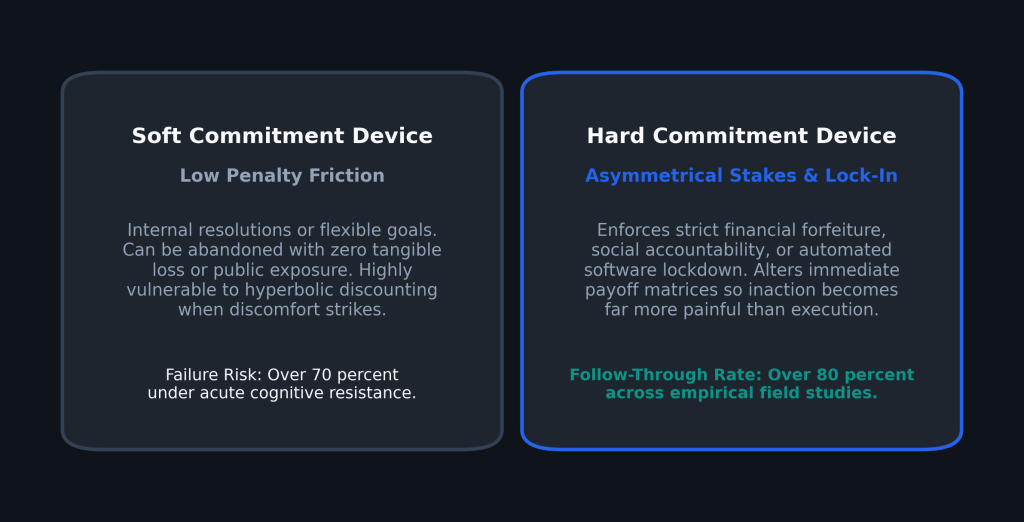
Hard vs Soft Commitment Devices
Understanding the spectrum of commitment mechanisms allows knowledge workers to deploy the proper caliber of constraint for their specific resistance levels:
- Soft Commitment Devices: Internal resolutions, habit trackers, or private promises. These carry low friction but high vulnerability. When fatigue sets in, soft commitments can be renegotiated with zero external penalty.
- Hard Commitment Devices: Legally, socially, or financially binding agreements where failure triggers an irreversible, painful consequence administered by a third party. Hard commitments permanently remove the option of quiet surrender.
The Three Operational Pillars of Hard Precommitments
- Asymmetrical Consequences: The penalty for failure must sting sufficiently to activate loss aversion.
- Neutral Third-Party Verification: A referee, automated webhook, or independent accountability partner must hold exclusive authority over whether the condition was met.
- Temporal Immutability: Once established, the contract cannot be cancelled, modified, or postponed by the participant.
Tactical Implementation Protocol
Implementing effective commitment devices requires a three-tier escalation ladder: deploy financial forfeiture contracts for high-stakes deliverables, social accountability pledges for recurring project milestones, and operating system software locks for daily focus containers.
Do not deploy nuclear-grade commitment devices on trivial daily chores. Reserve hard contracts for chronic bottlenecks and high-value strategic deliverables that repeatedly stall under normal willpower. Follow this tiered protocol.
Step 1: Deploy Financial Forfeiture Contracts
Financial loss aversion is one of the most powerful psychological drivers in human cognition. Use platforms like StickK or Beeminder to enforce high-friction stakes:
- Select an Anti-Charity: Choose a recipient organization whose values or political stances you strongly oppose. Transferring money to a beloved charity creates perverse incentives, as the brain rationalizes failure as a noble donation. Forfeiting capital to an opposing cause produces visceral revulsion that forces execution.
- Calibrate the Stake: The financial penalty must represent an uncomfortable sum (typically $50 to $250 for a professional). If the penalty is negligible, the brain simply treats it as an affordable fee to indulge in procrastination.
- Designate an Independent Referee: Never verify your own completion. Appoint an uncompromising colleague or neutral mentor who demands proof of shipped output before verifying success.
Step 2: Implement Social Accountability Pledges
Social reputation is a primary evolutionary driver. Harness social exposure to enforce project shipping:
- Public Milestone Pre-Commitment: Post a public deadline on LinkedIn, X, or an industry community: “The public beta of my application launches next Friday at 12:00 PM EST. If it is not live, I will refund all pre-orders and host a public AMA detailing why I failed.”
- Synchronous Peer Check-Ins: Schedule recurring, non-negotiable standup meetings with a fellow founder. If you fail to demonstrate tangible shipped work during the call, you owe your peer a predetermined favor or fine.
Step 3: Configure Automated Software Lockdowns
Eliminate the temptation to negotiate during deep work blocks by physically cutting off alternative paths:
- Operating System Blockers: Deploy tools like Cold Turkey or Freedom to hard-block non-essential websites, applications, and games. Configure them with locked timers that cannot be bypassed even by restarting the machine.
- Phone Quarantine Safes: Place your smartphone inside a timed physical lockbox (such as a kSafe) for three hours every morning. Removing the physical possibility of digital distraction restores focus effortlessly.
Tooling and Digital Ergonomics
Modern software automates commitment enforcement through API webhooks and algorithmic penalty tracking. Choosing the right tooling stack eliminates manual verification loopholes and maintains strict accountability.
Dedicated commitment platforms automate the mechanics of precommitment, ensuring that penalties execute automatically when targets are missed.
| Platform Category | Recommended Platforms | Enforcement Mechanism | Core Operational Strength |
|---|---|---|---|
| Financial Stakes | StickK / Beeminder | Direct credit card forfeiture | Connects to APIs (GitHub, Duolingo, Fitbit) for automated failure detection |
| Focus Lockdowns | Cold Turkey Blocker / Freedom | Kernel / OS-level process blocking | Unbypassable timed blocks prevent terminal and browser circumvention |
| Physical Hardware | kSafe / Kitchen Safe | Mechanical timer lockbox | Physical containment removes digital dopamine devices from arm’s reach |
| Social Pods | Focusmate / Flow Club | Synchronous video body doubling | Human presence provides real-time autonomic arousal and accountability |
Preventing System Tampering
The primary vulnerability of digital commitment devices is technical circumvention: modifying system clocks, editing hosts files, or using secondary devices. To prevent self-sabotage, password-protect administrative settings and give the recovery key to an accountability partner.
Failure Mode Recovery Protocol
When a commitment device fails due to unforeseen illness or operational emergencies, do not dispute the penalty. Accept the consequence cleanly, execute a post-mortem to diagnose the failure mode, and immediately re-commit with recalibrated scope.
Even hard contracts occasionally fail. How you respond to a forfeited stake dictates whether you build lasting resilience or abandon the methodology entirely.
Failure Mode 1: Penalty Dispute and Rationalization
When a deadline is missed, the ego instinctively rationalizes reasons why the penalty should be waived (e.g., client demands, unexpected fatigue).
- The Recovery Protocol: Enforce a zero-tolerance policy. Accept the financial or social penalty immediately without argument. The moment you successfully negotiate an excuse with your referee, the psychological integrity of all future commitment devices is permanently destroyed.
Failure Mode 2: Over-Commitment and Burnout
Setting aggressive, unrealistic stakes across ten simultaneous goals guarantees failure, exhaustion, and financial devastation.
- The Recovery Protocol: Limit active hard commitment devices to a maximum of two at any given time. Ensure that targets represent Minimum Viable Execution Units rather than overly optimistic heroic feats.
System Scalability and Long-Term Execution Habits
Commitment devices are temporary scaffolding, not permanent prisons. As repeated execution builds operational competence and professional identity, external stakes naturally give way to autonomous intrinsic momentum.
When you begin using hard commitment devices, external stakes do the heavy lifting of overcoming inertia. Over weeks and months of consistent follow-through, your self-concept undergoes a fundamental transformation. You stop viewing yourself as a procrastinator who needs external force and begin identifying as a high-velocity builder who finishes what they start.
Once robust execution habits and automated schemas take root in long-term memory, the need for extreme financial penalties recedes. The commitment device successfully serves its ultimate purpose: bridging the fragile early chasm between ambition and reality until disciplined momentum becomes your permanent baseline.
Frequently Asked Questions
What is a Ulysses contract in psychology?
A Ulysses contract (named after the mythological hero who bound himself to his ship’s mast to resist the Sirens’ song) is a freely made decision designed to bind yourself in the future when you anticipate your future self will be tempted by irrational impulses or fatigue.
What happens if I set a financial penalty to my favorite charity?
Setting a financial penalty to a charity you support weakens the commitment device. Behavioral economists find that when people fail on pro-charity contracts, their brains engage in moral licensing, rationalizing the failure as a benevolent charitable gift rather than a painful loss. Always choose an anti-charity or neutral recipient.
How do I prevent myself from cheating on a commitment device?
To prevent cheating, decouple verification from yourself entirely. Appoint an impartial referee who has sole authority to approve task completion, use automated software integrations that verify data through APIs, and lock blocker settings behind passwords you do not possess.
Are commitment devices safe for people with ADHD?
Yes, when calibrated properly. Neurodivergent individuals frequently experience temporal myopia, making distant consequences invisible. Commitment devices bring immediate, high-salience consequences into the present moment, supplying the external urgency required to stimulate dopamine and initiate task action.


